
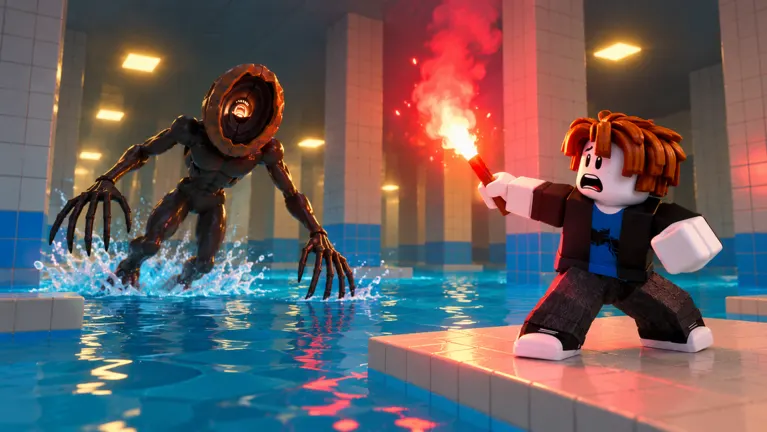
The hunter is blind and responds to splashes and other loud cues. Distraction means giving it a safer sound target while you move on dry tiles elsewhere.
Distraction is not invulnerability. You still fail if you splash during the crossing window or if a second noise pulls the entity back onto your arc.
Pebbles are the primary verified distraction tool in public guides. Treat other props as unconfirmed until you test them in your current build.
Understand the Monster's Behavior
On dry platforms you are silent to it. Any water disturbance becomes a navigation waypoint for the entity.
It commits hard once it selects a splash—use that commitment as your crossing window.
When the hunter passes close without a recent bait, assume you already made noise. Fix the splash source before throwing again.
Identify Sound and Environmental Cues
Pebbles create predictable distant splashes. Valves and certain doors create loud, fixed-location noise.
Listen for double splashes—you may have baited while also clipping water on takeoff.
Banner text and water color often warn when a room tolerates less noise. Combine visual read with audio spikes before you open loud objects.
How to Use Distractions
Throw pebbles past the farthest water from your route, wait for movement, then jump on the opposite side. Near-body throws pull the hunter toward your destination.
- Throw pebbles past the farthest water from your route.
- Wait for movement before jumping.
- Carry spare pebbles before long gaps.
- On narrow chains, bait from the previous dry tile—not from the tile you are leaving.
What to Do After Attracting Attention
Cross cleanly—do not throw again mid-air unless you aborted the line entirely.
If the hunter returns early, you likely landed near its path or made a secondary splash.
After a successful cross, pause on stable tile to listen. A quiet window means you can plan the next segment; footsteps in water mean reset bait.
Distractions During Valves and Group Play
Valves are loud events. Solo players should bait when the hunter is within threat range; multiplayer groups should assign one baiter so two throws do not cancel each other.
Call out when you are opening a valve so rear players do not jump into water thinking the hunter is still committed elsewhere.
Common Distraction Mistakes
- Baiting toward your destination instead of away from it.
- Opening valves without a prior bait.
- Sprinting into water because the bait “should” still be active.
- Throwing while standing on a sinking or rotating surface.
- Assuming seasonal hunter skins change audio rules—they do not replace splash logic.
Frequently Asked Questions
Do all items distract the monster?
Only confirmed noisy interactions count. Pebbles are the primary verified tool; verify other props in-game before relying on them.
Can the hunter see me on dry tile?
Public guides describe sound-based pursuit on dry routes. Still avoid crossing through its body path—physical contact ends runs regardless of bait.
How many pebbles per gap is enough?
One well-placed throw often suffices. Extra throws mid-cross add splash risk unless you aborted the line.
Should I bait every room?
Bait when the hunter is near your line or when you must cross wide water. Quiet empty rooms may not need a throw if you stay dry.